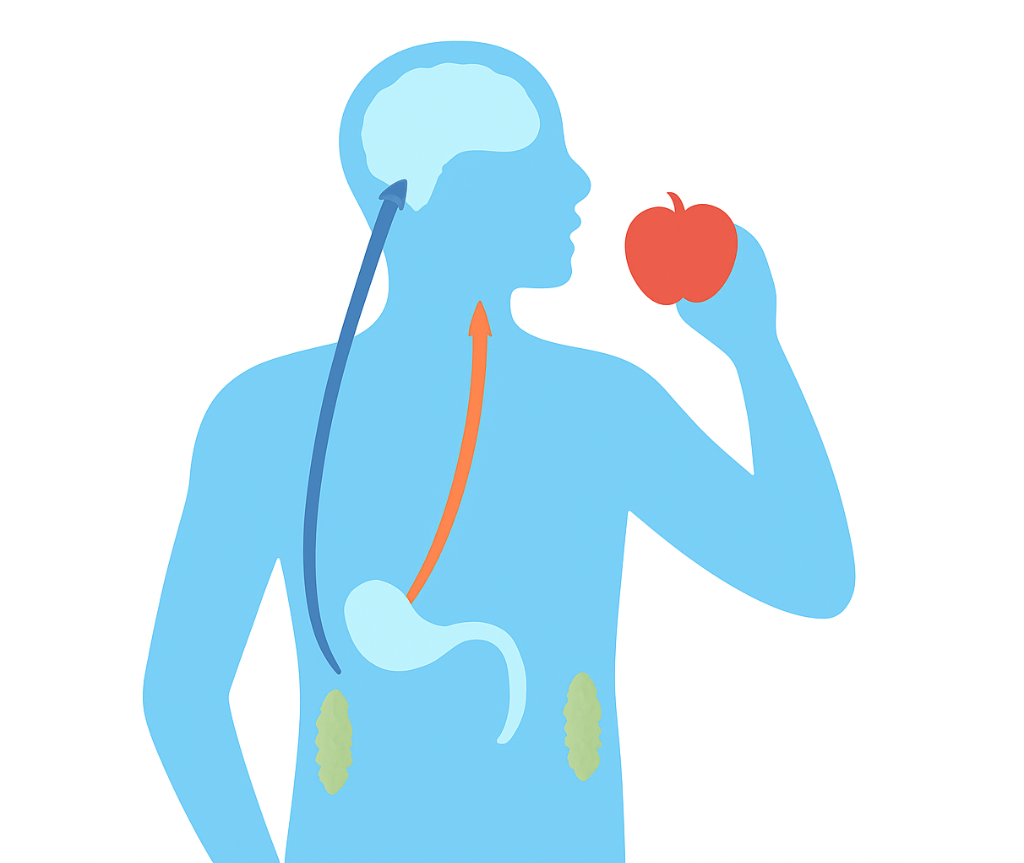

Your body has its own system for knowing when to eat and when to stop, and this system relies on hormones, not willpower.
Ghrelin tells your brain when you’re hungry. Leptin lets you know when you’ve had enough. GLP-1 and peptide YY slow digestion and help reduce your appetite after eating. When these signals work as they should, eating feels easy and natural.
But things like ultra-processed foods, poor sleep, chronic stress, and crash diets can all disrupt this system. When that happens, you end up feeling truly hungrier, not just lacking discipline.
When you understand how these hormones work, you can work with them instead of against them.
If you’ve ever finished a meal and felt hungry again an hour later, you know how confusing that can be. You ate enough. You know you ate enough. But something in your body didn’t get the message. That gap between what you’ve eaten and how hungry you still feel isn’t about self-control. It’s a communication problem, and it starts with hormones.
Your body is always running a system that keeps track of your energy, how much you’ve eaten, and when it’s time to eat again. When this system works well, hunger feels predictable. You get hungry before meals, feel satisfied after, and stay comfortable in between. But when it gets disrupted by what you eat, how you sleep, or your stress levels, the signals can get mixed up.
Sometimes hunger shows up when it shouldn’t, and fullness never really arrives. No amount of willpower can fix a broken signal. Learning which hormones control this system and what can throw them off can completely change how you think about hunger.

Why Hunger Is a Hormone Problem, Not a Willpower Problem
Hunger isn’t a character flaw. It’s a message. Your gut, fat cells, bloodstream, and brain are always talking to each other, sending signals about how much energy you need and how much you have. Hormones control almost all of this conversation.
When everything works as it should, you feel hungry before meals and satisfied after eating. You don’t have to count calories or restrict yourself to feel full. But for most people, that natural rhythm is missing. Many find themselves craving snacks after dinner, feeling unsatisfied at lunch, or waking up hungry even after eating enough the night before.
Something is disrupting the system. Usually, the problem isn’t with the person, but with the signals themselves.
Four main hormones control most of this process: ghrelin, leptin, GLP-1, and peptide YY. Each hormone has its own job and can be affected in different ways. Once you know what they do, the patterns become much clearer.
Ghrelin: The Hormone That Tells You to Eat
Ghrelin is mostly made in your stomach, and its main job is to signal your brain when it’s time to eat. Its levels go up before meals and drop afterward. You can think of it like a kitchen timer that goes off at set times, even if the food isn’t ready yet.
That timing is more important than many people think. Ghrelin doesn’t only react to how empty your stomach is; it also responds to your habits. For example, if you eat lunch at 1 pm every day, your body will start making ghrelin around that time, even if you had a big breakfast and aren’t very hungry. Your body learns your routine and gets ready for it.
That same timer can also be triggered by other things. Ghrelin goes up after a bad night’s sleep, when you’re eating fewer calories, or when you’re stressed. This is why dieting often feels harder the longer you stick with it: your body is making more of the hormone that pushes you to eat. It’s not a weakness. It’s just biology.
One of the best ways to manage ghrelin is to eat at regular times each day. When you keep a steady meal schedule, your body knows when to expect food, so ghrelin levels rise and fall in a predictable pattern. Eating at random times can lead to more sudden hunger throughout the day.
Leptin: The Signal That Should Tell You to Stop
If ghrelin starts hunger, leptin is the signal to stop. Fat cells make leptin, which tells your brain that you have enough energy stored, so you can stop eating and stop feeling hungry. In theory, people with more body fat should make more leptin and feel less hungry. In reality, the opposite often happens.
This is due to a problem called leptin resistance. Over time, the brain can stop responding to leptin, even when there is plenty of it. The signal is present, but the brain no longer hears it. As a result, hunger continues even when the body has enough energy stored.
Ultra-processed foods, chronic inflammation, and poor sleep all contribute to leptin resistance. It develops slowly, which makes it hard to notice. The result is hunger that doesn’t go away after eating, trouble feeling satisfied even after a full meal, and ongoing cravings, especially for high-calorie foods.
What Leptin Resistance Actually Feels Like
Most people who experience leptin resistance don’t know that’s what’s happening. They just know that eating doesn’t fix their hunger the way it used to. A few signs worth recognizing:
- Hunger that returns quickly after a full meal
- A sense of never quite feeling satisfied, even when eating enough
- Strong, specific cravings — usually for sweet or fatty foods
- Feeling tired and hungry at the same time, often in the afternoon
None of these are personality traits. They’re signals from a system that isn’t communicating clearly. And that’s important to understand, because the path forward isn’t more restraint — it’s supporting the system itself.
GLP-1 and Peptide YY: The After-Meal Messengers
Although GLP-1 and peptide YY are not widely recognized by the general public, these two hormones play a significant role in postprandial satiety. Both are secreted by the gastrointestinal tract in response to food intake and signal the brain to reduce appetite.
Glucagon-like peptide-1 (GLP-1) is released in the small intestine during and after meals. It slows gastric emptying, thereby prolonging the time food remains in the digestive system. GLP-1 also interacts directly with appetite-regulating centers in the brain, diminishing the drive to continue eating. Peptide YY, which is secreted further along the digestive tract, functions similarly and contributes to the sensation of satiety following food consumption.
Both GLP-1 and peptide YY are strongly stimulated by dietary protein and fiber. Meals rich in these components elicit a more sustained release of these hormones compared to meals composed primarily of refined carbohydrates, even when caloric content is equivalent. This hormonal response explains why a breakfast containing eggs and vegetables promotes greater satiety than one consisting of toast and jam. The effect is not solely due to fiber content, but rather the specific hormonal responses elicited by different foods.
Another important hormone is cholecystokinin (CCK), which is released in the small intestine in response to dietary fat and protein. CCK provides an additional satiety signal following food intake. Collectively, GLP-1, peptide YY, and CCK constitute a postprandial signaling system that, when functioning optimally, facilitates the cessation of eating with minimal effort.
What Disrupts Your Satiety Signals (and Why It Matters)
It’s helpful to know these hormones exist, but it’s even more useful to understand what can disrupt them. In modern life, four main patterns interfere with satiety hormones more than anything else.
- Ultra-processed foods are made to be eaten quickly and are hard to stop eating. They usually have little protein and fiber, which are the main triggers for GLP-1 and peptide YY. Because these foods digest so fast, your gut doesn’t have enough time to release enough fullness hormones before you take another bite. Eating these foods regularly can also cause chronic inflammation, which leads to leptin resistance.
- Not getting enough sleep changes your hormones overnight, and it’s hard to make up for it the next day. Even one bad night can raise ghrelin and lower leptin. When you’re tired, your brain also reacts more strongly to high-calorie foods. This means you feel hungrier, don’t feel as full after eating, and have a harder time resisting foods you normally wouldn’t want. More on this in How One Bad Night’s Sleep Makes You Hungrier the Next Day.
- Chronic stress raises cortisol, which makes your body less sensitive to leptin. If cortisol stays high for a long time, your brain doesn’t respond as well to the signals that tell you you’re full. This often leads to cravings for sugar and fat, as your body looks for quick energy when it feels threatened. More on this in Why Stress Makes You Hungry Even When You’ve Already Eaten.
- Crash dieting sets off a long-lasting hormonal response that actually makes losing weight harder. When you cut calories too much, ghrelin goes up, and leptin goes down, and these changes can last for months after the diet ends. Your body sees this restriction as a famine and changes your hunger signals. That’s why many people feel hungrier after a diet than before. The hormones have shifted in the wrong way.
How to Support Your Hunger Hormones Through Food and Lifestyle
This doesn’t mean your system can’t change. Your hormones react to what you eat, how well you sleep, and how you handle stress. Making small, steady changes can shift things in a positive way over time.
- Make sure to get enough protein with every meal. Protein is the most powerful food trigger for GLP-1 and peptide YY. Having a good protein source at breakfast, lunch, and dinner helps your fullness hormones work well. Some good choices are eggs, fish, legumes, poultry, Greek yogurt, and cottage cheese.
- Include plenty of fiber in your meals as well. Soluble fiber slows digestion and keeps GLP-1 active longer, so you feel full for longer after eating. Gut bacteria that eat fiber also make short-chain fatty acids, which help trigger GLP-1 on their own. Vegetables, legumes, oats, and fermented foods all help with this. More on this in “fermented foods and gut health.”
- Try to eat at the same times each day. Keeping a regular meal schedule helps keep ghrelin levels steady. When your body expects food at certain times, hunger becomes more predictable, and those random afternoon cravings happen less often.
- Take your time when you eat. GLP-1 and peptide YY need about 15 to 20 minutes to reach their highest levels after you begin eating. If you finish your meal in just 10 minutes, those fullness signals show up after you’ve already gone back for more. Eating slowly gives your hormones time to work. Why Eating More Slowly Changes How Much You Eat goes into this in more depth.
- Take care of your sleep. Even small improvements in sleep quality can help balance ghrelin and leptin in just a few days. Sticking to a regular sleep schedule, by going to bed and waking up at about the same time each day, is one of the best things you can do for your hunger hormones. For practical strategies, see 10 Ways to Actually Sleep Better.
- Be intentional about managing stress. Ongoing stress raises cortisol levels, which make your body less sensitive to leptin. Exercise, spending time outside, and even short daily breaks for real rest can help lower cortisol over time. You can find more specific tips for the stress-hunger link in Why Stress Makes You Hungry Even When You’ve Already Eaten.
What Your Hunger Has Been Trying to Tell You
If you’ve ever felt frustrated with yourself for being hungry too often or eating more than you planned, it’s important to remember that your hunger was sending you a real message. It just might not have been the message you thought it was.
These hormones aren’t obstacles. They are part of a system that evolved to keep you alive and energized. When this system gets out of balance, hunger isn’t a sign of weak willpower. It just means the signals are off and need support, not that they should be ignored.
Pick one thing to try tomorrow. Add some protein to your breakfast. Try eating your meals a bit more slowly this week. Make going to bed earlier a priority tonight. These changes won’t solve everything right away, but they all help move your system toward clearer signals and hunger that makes sense. If your hunger is still hard to manage no matter what you eat or how you sleep, consider talking to a doctor or healthcare provider. Sometimes there’s something else going on, and it’s worth checking out.