
When you start looking into Pilates, the mat vs reformer question comes up fast. Studios promote reformer classes. Online programmes lead with mat work. It can feel like you have to pick the right one before you even begin.
Both options work. They share the same core principles and deliver the same benefits: better strength, control, and body awareness. The real difference is in how they challenge you, not whether one outperforms the other.
Understanding that takes the pressure off the decision and helps you choose what actually suits your life right now.
The Foundation They Share
Both mat and reformer Pilates come from the same system Joseph Pilates developed. His method was designed to strengthen your body evenly, support your spine, and encourage efficient, controlled movement.
Whatever format you choose, you’re working with the same principles: precise movement, breath that supports stability, core strength and alignment, and gradual progression rather than exhaustion. The philosophy stays consistent. Only the tools change.
What Is Mat Pilates?
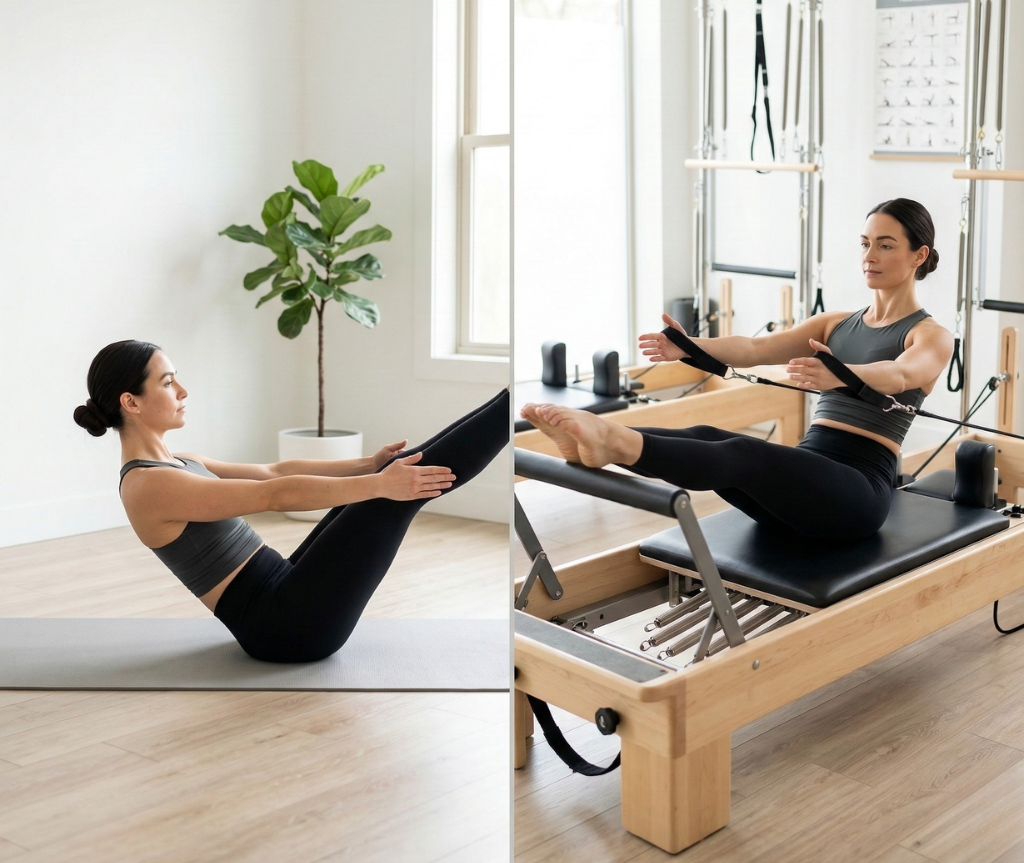
Mat Pilates is done on the floor using a mat, sometimes with small props like resistance bands or soft balls. You work with your body weight, gravity, and the leverage created by how you position your limbs.
Because there’s no external equipment helping you, your core and hips have to provide all the stability. That makes mat work genuinely demanding in its own way, and it’s excellent for building alignment awareness from the ground up.
Mat Pilates is also accessible. You can practise at home, take it with you when travelling, and start without spending much money. That combination of depth and simplicity is a big part of its appeal.
What Is Reformer Pilates?
Reformer Pilates uses a spring-based machine with a moving carriage, straps, and adjustable resistance. You can increase the spring tension to make exercises harder or reduce it for more support. That flexibility is why you’ll find reformers in both fitness studios and physiotherapy clinics.
Many people find the reformer helps them feel correct movement patterns more easily. The resistance gives clear physical feedback. The structure of the machine guides your alignment. For people managing injuries or limited mobility, that support can make a real difference to how quickly they progress.
How Mat vs Reformer Pilates Feel Different
Even when you’re doing similar exercises, the experience is quite different between the two.
Mat Pilates often feels more demanding on your core control. Exercises look simple, but can be hard to hold steadily. The whole experience feels grounded and minimal. There’s nowhere to hide when your core starts to fatigue.
Reformer Pilates tends to feel smoother and more fluid. The moving carriage creates a more dynamic experience. The resistance feels supportive yet surprisingly intense. Some people find it more motivating because the machine gives you a tangible sense of working against something.
Mat vs Reformer Pilates for Beginners: Which Should You Start With?
This depends more on you than the method itself. Both work well for beginners. The question is which environment helps you show up consistently.
Mat Pilates suits you well if you want flexibility and low cost, prefer learning at your own pace, or feel comfortable working without equipment. Reformer Pilates tends to work better if you benefit from physical guidance, are working around pain or movement limitations, or find structured studio environments more motivating.
Either way, the quality of instruction matters more than the format. A good teacher can adapt a mat or reformer to meet you exactly where you are.
Is One Harder Than the Other?
You might have heard that reformer Pilates is always harder. That’s not accurate.
Mat Pilates can be extremely challenging because your body stabilises against gravity with no assistance at all. Your core has to do all the work. Reformer Pilates allows you to adjust resistance easily, so exercises can be gentler or more demanding depending on how you set it up.
In practice, mat Pilates tends to build strong foundational control. Reformer Pilates allows clearer progression through added resistance. Many people find that mixing both over time gives them the most balanced result.
The Practical Side: Cost, Access, and Convenience
Logistics matter, and they often end up being the deciding factor.
Mat Pilates costs very little to start. You need a mat, and that’s mostly it. You can practise anywhere: at home, in a park, in a hotel room. Reformer Pilates requires access to a studio or gym, and session costs are higher due to the equipment and smaller class sizes.
The most effective choice is usually the one you can practise consistently. If reformer classes fit your schedule and budget, great. If mat Pilates works better for your life right now, that’s just as valid. Many people try both at different points and settle into whichever suits them best at the time.
Can You Switch Between Mat and Reformer Pilates?
Yes, and many people do. Pilates was never designed as an either-or system.
Some people start with mat Pilates and add reformer sessions later. Others alternate depending on their goals, schedule, or how their bodies feel that week. Mat work deepens your control and awareness. Reformer work adds variety and resistance.
Used together, they complement each other well and give you more ways to challenge your body as your practice develops.
A Simple Way to Make Your Decision
If simplicity, flexibility, and independence appeal to you, start with mat Pilates. You can begin today with just a mat and an online class. You’ll build strong foundational control without spending much, and you can practise anywhere.
If guidance, physical resistance, and a structured studio environment feel more supportive, try reformer Pilates first. You’ll get hands-on instruction, equipment that helps you find the right positions, and a social setting that many people find motivating.
The Choice That Actually Matters
Both formats teach you the same principles. Both build core strength, improve your posture, and help you move with more control and less strain. The path you take is less important than your consistency and attention to technique.
Start with whichever option feels more accessible or appealing right now. You can always try the other format later, switch between them, or combine both as your practice grows.
The most important thing is that you’re moving in a way that supports your body long term. Either format can get you there.